Is Parasailing in St Maarten Safe? Honest Answer + Who Shouldn't Go

Is parasailing in St Maarten safe? Statistically, yes: US Coast Guard data across an estimated 3 to 5 million parasail rides a year puts serious incidents in the single digits annually, and no comparable St Maarten-specific statistic exists to point to instead, which I'll say plainly rather than invent one. It isn't risk-free, and it genuinely isn't for everyone. Pregnancy, certain weight and age limits, and a couple of health conditions rule some travelers out entirely. Below is the real regulation that governs the Orient Bay flight, the honest risks and how a good crew manages them, and the full restrictions table, weight in pounds and kilograms, that tells you plainly whether you can fly.
Quick answer
Parasailing in St Maarten is statistically very safe: US Coast Guard data across roughly 3 to 5 million rides a year puts serious incidents in the single digits annually. It isn't risk-free, and it genuinely isn't for everyone.
Key takeaways
- The safety-record headline: single-digit serious incidents annually across millions of rides nationwide; no St Maarten-specific figure exists
- Orient Bay operators work under French maritime rules for towed watersports, not a US state statute
- The two biggest exclusions by name: pregnancy, and a combined weight over the boat's limit
- Vet an operator on their briefing, their orange signal flag, and their willingness to ground flights in bad wind
- The full weight, age and health restrictions table is below, in pounds and kilograms
Who Should Think Twice Before Flying
If you're pregnant
this activity is generally excluded due to the harness jolt on launch and landing; see the alternatives below.
If you have a recent neck, back or heart condition
talk to your doctor first and disclose it honestly when you book.
If your group's combined weight is near the boat's limit
confirm the individual and combined caps before booking a tandem or triple flight.
If you have mobility concerns
flag it before booking; the jet-ski shuttle out to the boat is the bumpiest leg of the trip, not the flight.
If you have epilepsy
there's no formal exclusion for the flight itself, but discuss heat and sun exposure with your doctor first.
How Safe Is a Flight Over Orient Bay, Really?
The honest starting point is a real number, not a marketing line. US Coast Guard data across an estimated 3 to 5 million parasail rides a year in the United States puts serious incidents in the single digits annually. No comparable St Maarten-specific statistic exists, and I won't pretend one does just to sound reassuring; the national picture is the best available evidence, and it points toward this being one of the statistically safer watersports a traveler can try.
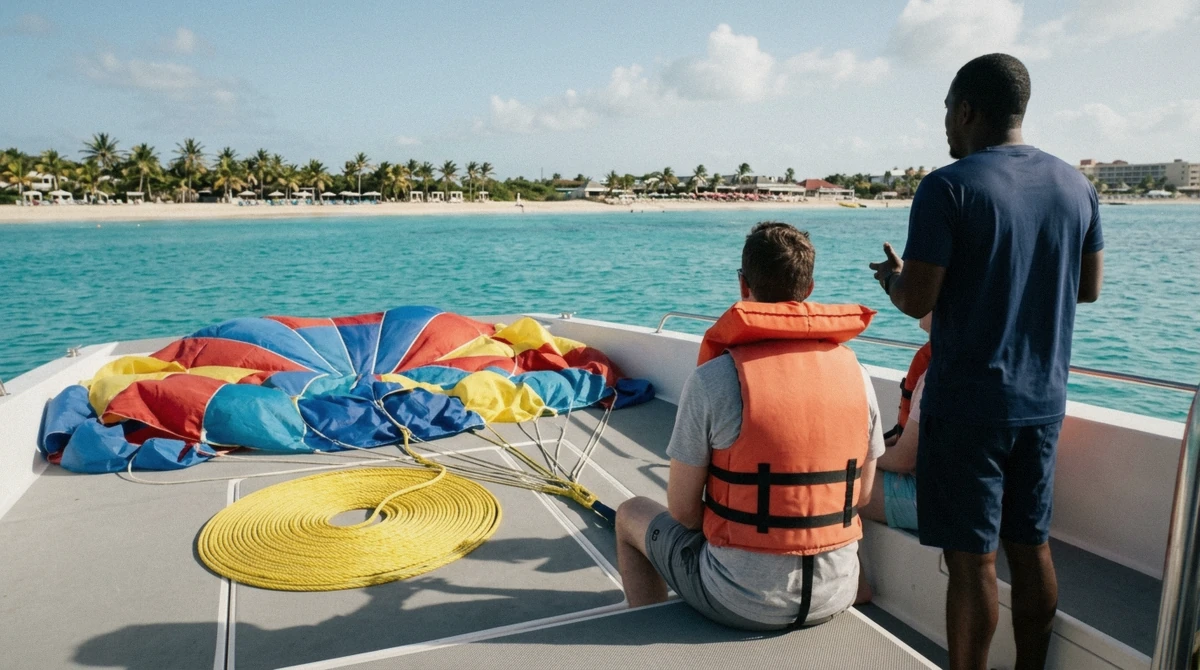
On the boat itself, launch and landing happen on the deck by winch, not by running off a dock or jumping, and a life vest is fitted over the harness at the safety briefing before anyone boards. That structure removes the two riskiest moments of most watersports, the entry and the exit, from the flight entirely.
Who Regulates Parasailing Here: French Rules, Not a US Statute
Orient Bay sits on the French side of the island, so the operators here work under French maritime rules for towed watersports, not any US state's parasailing statute. Being honest about that distinction is the right framing, rather than implying an American-style regulatory regime that doesn't apply here.
- Daylight hours only, no towed flights after dark
- Flights must stay outside the 300-meter shore band except through marked channels (chenaux)
- The towing boat must be able to carry every towed person aboard if needed
- Two crew are required on the towboat: one driving, one watching the flyers and handling recovery, ask who your observer is
- A fluorescent orange signal flag must be displayed on the towboat while flights are in progress
Orient Bay's northeast waters also border the Réserve Naturelle de Saint-Martin, roughly 3,060 hectares of protected coastline that includes Pinel Island and Green Cay. Motorized watersports are restricted inside the reserve's zones, which in practice keeps the flight corridor out of Orient Bay well defined rather than free-roaming. The flight you'll book runs the Orient Bay parasail flight we cover on this site, operating inside that framework.
Where Things Can Go Wrong, and What the Boat Crew Does About It
Real risk mechanisms specific to this activity, each paired with what a competent crew actually does about it.
| Situation | What a good operator does | Warning sign |
|---|---|---|
| Gusts pick up mid-session | The captain's go/no-go call grounds flights outright rather than pushing a marginal gust window | A crew launching flights while visibly discussing wind on the radio |
| The jet-ski shuttle out to the boat | A trained operator runs a steady, controlled ride and helps riders on and off at both ends | A rushed handoff with no assistance stepping onto the jet ski or the boat |
| A rider is nervous about the harness or the winch | A full briefing before boarding, questions answered, no pressure to rush | A crew that skips the briefing or waves people straight onto the boat |
| Overloading a triple flight | Weighing riders honestly against the boat's combined limit and declining if it's close | A crew that eyeballs weight instead of asking or checking |
Of everything on this list, the jet-ski shuttle from Bikini Beach to the parasail boat is the wettest, bounciest part of the whole trip, more so than the flight itself, so it's worth flagging any mobility concern before you book rather than discovering it on the water.
Reading an Operator Before You Hand Over $80
Green flags worth watching for before you board: a fitted harness check by the crew, a real briefing rather than a rushed signature on a waiver, an orange signal flag flying on the towboat, and published weight rules the crew actually applies rather than eyeballing.
- Green flag: a proper harness fit-check, not a quick tug
- Green flag: a briefing that covers what to do if you want the splash dip or want to skip it
- Green flag: the orange signal flag visibly flying during flights
- Red flag: overloading a triple flight past the published combined limit
- Red flag: no second crew member watching the flyers, just the driver
- Red flag: launching inside the marked swim zone instead of the designated corridor
One more practical flag worth adding: unattended bags or valuables at a busy beach hut check-in are a property risk, not a physical-safety one, but they're worth keeping in view all the same, the beach hut gets crowded on cruise mornings. These are the checks I'd run on any boat anywhere, including the $80 Orient Bay flight featured on this site, and if you're weighing what that $80 actually buys, our cost breakdown for a parasailing day itemizes it.
Weight, Age and Health Limits on Orient Bay Boats
Every restriction below reflects what Orient Bay's actual boats enforce, not a generic industry guess.
| Restriction | Typical rule on Orient Bay tours | Why it exists | Ask before booking if... |
|---|---|---|---|
| Pregnancy | Excluded | The harness jolt on launch and landing carries real risk during pregnancy | You're pregnant at any stage |
| Minimum age (solo) | Typically from 10 years old | Younger riders don't reliably meet the harness fit or weight floor for a solo flight | Your child is under 10 and wants to fly alone |
| Minimum age (tandem) | From as young as 2 with an adult on some boats | A tandem harness with an adult supports much younger riders safely | Your child is very young and you want to fly together |
| Weight, individual and combined (solo/tandem) | Up to about 440 lbs / 200 kg under the canopy | The canopy and winch are rated to a maximum lift weight | You or your combined tandem pair are near this limit |
| Weight, combined (triple) | Up to about 330 lbs / 150 kg combined | Three riders under one canopy lowers the safe combined ceiling | Your group of three is close to this combined total |
| Heart condition | Excluded | The launch and landing jolt is a real strain risk | You have a diagnosed heart condition |
| Recent neck or back problems | Excluded | The same harness jolt can aggravate a healing injury | You've had recent neck or back surgery or injury |
| Swimming ability | Not required | Launch and landing happen on the boat deck by winch, not in the water | You're a non-swimmer and want reassurance, this genuinely isn't a barrier here |
Minimums and the exact final call on a borderline case shift with the day's wind, the captain decides on the day, so treat the table above as the standard rule, confirmed at booking, not an absolute guarantee for every edge case.
If the Wind Turns Mid-Flight: Honest Scenarios
Gusts pick up while you're already in the air
What happens: trade winds occasionally spike beyond the comfortable range mid-session. What the crew does: the boat's captain shortens the flight and winches you down early rather than extending it. What you do: stay relaxed in the harness, this is a routine call, not an emergency, and follow the crew's radio instructions if they call anything down to you.
The flight gets grounded before you even go up
What happens: the captain's go/no-go call keeps flights on the beach when gusts spike beyond the safe window. What the crew does: reschedules you for a calmer slot the same day or a later one, or arranges a refund through the booking platform. What you do: build a little flexibility into your day if you're on a tight cruise schedule, since a weather hold is a safety call, not a service failure.
Hurricane-season timing
St Maarten's hurricane season runs 1 June through 30 November, peaking in September and October. The island rebuilt after Hurricane Irma made Category 5 landfall on 6 September 2017, and today's boats and gear all post-date that storm. Travelers flying in that window should book with a flexible mindset and watch the forecast rather than assume clear skies, and free cancellation up to 24 hours before your slot covers exactly this kind of plan change.
Our month-by-month wind and season guide covers which weeks carry the highest scrub odds.
Across every scenario above, one lever matters most and it's entirely within your control: choosing a licensed, transparent operator and disclosing any medical condition honestly at booking does more for your outcome than anything that happens once you're on the water.
Grounded by the Limits? Other Ways Onto the Bay
If pregnancy, a combined-weight limit or a health exclusion rules you out, Orient Bay itself doesn't rule you out of the water. Snorkeling gear rental and calm-water swimming right off Bikini Beach give you the same turquoise water and reef views without a harness or a winch involved, and a companion who can fly can still go up while you watch from the sand or the beach club deck next door. It's a genuine trade-off, not the same experience, but it keeps the day at Orient Bay worthwhile either way.
Parasailing Safety Questions, Answered
Has anyone died parasailing in St Maarten?
No St Maarten-specific fatality record is publicly available to cite, and this guide won't invent one. The best available evidence is the US Coast Guard's national data, roughly 3 to 5 million rides a year with serious incidents in the single digits annually.
Is there a weight limit for parasailing in St Maarten?
Yes, both individual and combined. Solo and tandem flights top out around 440 lbs / 200 kg under the canopy, and triple flights around 330 lbs / 150 kg combined. Confirm your group's total against these caps before booking.
Is there an age limit for parasailing in St Maarten?
Solo flights are typically available from around 10 years old. Younger children, from as young as 2 on some boats, can fly tandem with an adult. There's no published upper age ceiling beyond the general health exclusions.
Can you parasail in St Maarten while pregnant?
No. Pregnancy is a standard exclusion on Orient Bay boats because the harness jolt at launch and landing carries real risk. See the alternatives section above for what you can still do at the bay.
Is it safe for someone with a heart condition or high blood pressure?
It's excluded as a standard precaution, since the launch and landing jolt is a genuine strain risk. Talk to your doctor before booking if you have a diagnosed condition.
Is parasailing in St Maarten safe for non-swimmers?
Yes. Launch and landing happen on the boat deck by winch, not in the water, so swimming ability isn't a real factor for the flight itself. The jet-ski shuttle out to the boat is the one leg where you'll get splashed.
What happens if the weather turns bad mid-flight?
The captain shortens the flight and winches you down early if gusts spike while you're airborne, or grounds flights before they launch. Either way, you're rebooked or refunded through the booking platform rather than charged for a scrub.
Parasailing in St Maarten is safe by the numbers that actually exist: a statistically low-incident watersport, run under French maritime rules, with a captain who grounds flights rather than push marginal wind. It genuinely isn't risk-free, and it genuinely isn't for every traveler, pregnancy, certain heart and back conditions, and combined-weight limits rule some people out honestly. The one thing most within your control is disclosing any condition honestly and choosing a transparent operator before you pay.
If you've decided it's for you, our is parasailing in St Maarten worth it guide covers the rest of the decision.